
Introduction to and comparison of blow molding and injection molding
Blow molding and injection molding are two common plastic forming methods in modern industry.
Blow molding, also called hollow blow molding, is a rapidly developed plastics processing method. During World War II it was used to produce small low-density polyethylene bottles. In the late 1950s, the emergence of high-density polyethylene and development of blow molding machines led to widespread adoption. Hollow containers can reach several thousand liters, and some production is computer-controlled. Suitable materials include polyethylene, PVC, polypropylene and polyester. The hollow containers are widely used for industrial packaging. Depending on parison preparation, blow molding is divided into extrusion and injection blow molding; newer methods include multilayer and stretch blow molding.
Injection molding uses pressure to inject molten plastic into a mold, where it cools into the desired part. Dedicated injection molding machines are used. Common materials include polyethylene, polypropylene, ABS, PA and polystyrene.
What are the differences and characteristics of the two processes?
Characteristics of blow-molded products
Surfaces may be rough, dull and have blow molding marks.
Parting lines may be less attractive and prone to scratching.
The process is suited to simple shapes such as bottles and jars, with less sharply defined contours. Not all plastic grades are suitable; the document lists ABS and glass-filled nylon as examples.
Feed openings and gates may be difficult to arrange and less attractive.
Blow molding is commonly used for everyday products.
A major advantage is low cost.
Characteristics of injection-molded products
Smooth surfaces can provide a high-quality appearance, such as lamp components.
Gates and parting lines can be free of flash, burrs and rough edges.
Suitable for various shapes, with clear contours, high dimensional accuracy and a wide range of plastics.
Mating dimensions are readily controlled.
Assembly and fit between parts are relatively easy to achieve.
Costs are relatively high.
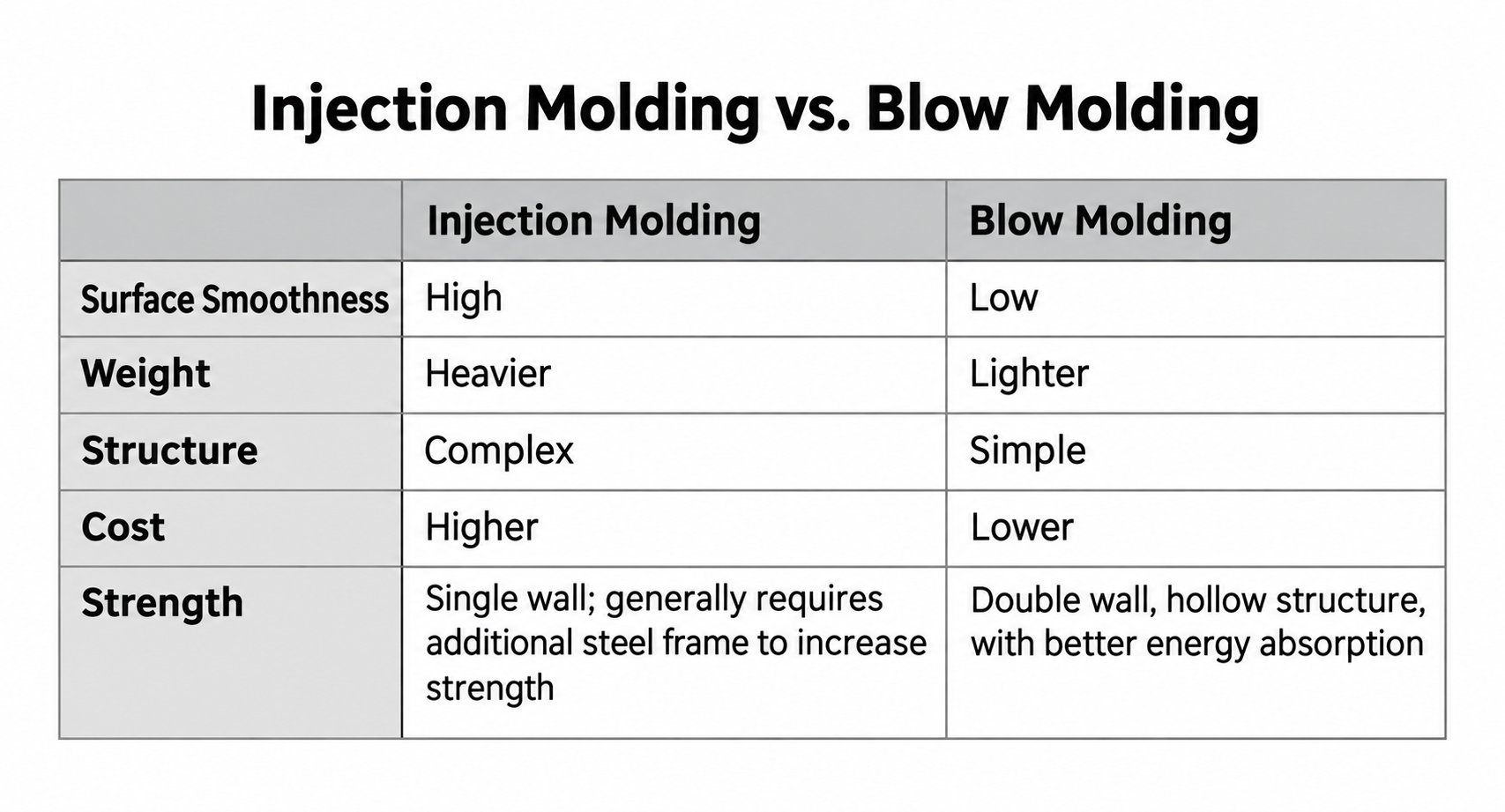
Generally, blow molding can form large thin-walled products and accommodate undercuts. Its main advantage is low equipment and tooling cost, making it economical. However, material limitations and low forming pressure make it less suitable for complex structures, uneven or thick walls and parts with inserts. Blow-molded products may also have uneven wall thinning, dimensional instability and more secondary processing. Injection molding can produce parts of different shapes and sizes, complex structures and high dimensional accuracy, with short cycles and widespread applications.
As a professional injection molding manufacturer, Customization Tech provides high-precision injection mold manufacturing and product molding. For inquiries, please email customizationtech@gmail.com.